Law.com Home Newswire LawJobs CLE Center LawCatalog Our Sites Advertise An ALM website
New York Lawyer

Home | Register | Login | Classified Ads | Message Boards

Search
 
Law Firms
New! Hard Times
NYLJ Professional
Announcements
Lawyer to Lawyer
The NYLJ 100
The AmLaw 100
The AmLaw 200
The AmLaw Midlevel
Associates Survey
The Summer
Associates Survey
The NLJ 250
 
Beyond Firms
The New York Bar Exam
Pro Bono
New! Lifestyles
NYLJ Fiction Contest
 
You Passed!
 

Get Advice
Advice for the Lawlorn
Crossroads
Message Boards
Services
Contact Us
Corrections
Make Us Your
Home Page
Shop LawCatalog.com
This Week's
Public Notices
Today's Classified Ads
Who We Are
Public Notices
Create a Domestic LLC/LLP Public Notice
Place a Foundation Ad


Pro Bono
New York City Pro Bono Training Calendar
New York State Pro Bono Opportunities Guide


New York Lawyer | July 27, 2010

Reprints & Permissions

NY Partner and Associate Aid Haitian Farmers

Subscribe to the New York Law Journal - 30 Days Free!


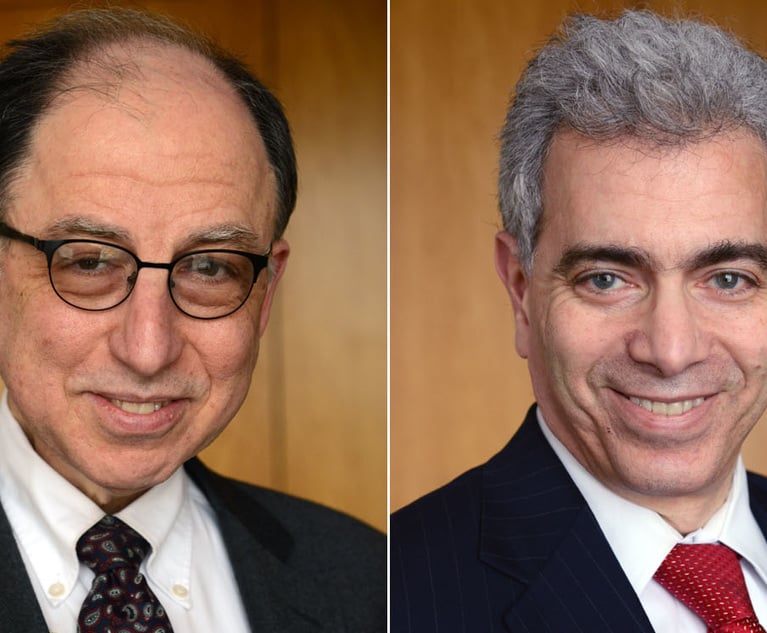
Ralph Delouis, left, and R. Andrew Richards, of McCarter & English set up a microfinance program to help victims of the January earthquake.
Rick Kopstein | NYLJ

Ralph Delouis and R. Andrew Richards scarcely knew one another at the New York offices of McCarter & English before their June mission to Haiti, which had been ravaged by the aftermath of January's earthquake. But what they had in common was personal experience in how random disaster may alter and upend everyday life. And each knew that their own well-being carried with it a debt to others.

They paid back in the way that lawyers can: with pro bono service, namely by creating a microfinance institution that will help make ends meet for as many as 5,000 subsistence farmers in Haiti.

During a week-long stay in Port-au-Prince, Messrs. Richards and Delouis filed a business charter with the Haitian financial ministry that enabled their client, an alliance of nonprofit financial groups, to begin extending critical loans to small-scale farmers affected by the earthquake.

Mr. Richards, a corporate and banking law partner at McCarter & English, said a typical customer with a few acres of land would receive a bridge loan of $200, which would mature in less than a year at a monthly interest rate of about 2 percent.

"Borrowers need financing to buy seeds, fertilizer and equipment, or simply because all of their savings are tied up in the crops," said Mr. Richards. "Sale of the crops at harvest time produces cash, so the institution wants its loan to mature then and be repaid while there is cash in hand."

Marie-Claude Jean-Baptiste, a Haitian-born attorney with the Human Rights Program of the New York-based International Senior Lawyers Project, knew of Mr. Richards' recent microfinance work as a Peace Corps volunteer in Africa. In recruiting him for similar duty in Haiti, she bypassed all other pro bono attorneys in the project's database.

Mr. Delouis' services were suggested by Emily Goldberg, pro bono coordinator at McCarter & English. Mr. Delouis, a corporate litigation associate, is the son of Haitian immigrants.

Ms. Jean-Baptiste said the charter drafted by the two-man McCarter & English team, including incorporation papers and credit verifications, established a precedent in Haitian legal history.

"This was uncharted territory," said Ms. Jean-Baptiste, an alumnus of George Washington University Law Center. "I don't think a Haitian lawyer could have accomplished what Andy Richards and Ralph Delouis accomplished."

She added, "What they did is so important, especially after the earthquake. Many in Port-au-Prince have little choice but to go back to their home provinces, which puts added pressure on the agricultural economy."

According to government estimates, the earthquake killed nearly a quarter-million people, injured another 300,000 and left 1 million homeless.

Brush With Disaster

Mr. Richards was among the thousands running through the streets of lower Manhattan on Tuesday morning Sept. 11, 2001, to avoid toppling buildings. And on a Tuesday afternoon last January, Mr. Delouis, a corporate litigation associate, was stunned by the news alert of a 7.0 magnitude earthquake in Haiti, where his mother and brother had just arrived; where a cousin and uncle lived and ultimately died.

As Mr. Richards said of such experiences, "It's a time for assessing the important things."

Accordingly, the two men volunteered their professional expertise in drafting documents for use by nonprofit lenders in Haiti's agricultural sector, united by the "umbrella organization" that became the McCarter & English pro bono client. Mr. Richards said he is obliged to keep the organization's name a confidence.

Last month, Messrs. Richards and Delouis formalized their efforts by filing a business charter with the Haitian government. Mr. Richards said the transparency of a charter would allow his client to grow an existing fund of $200,000 to $1 million or more by providing foundations and other donor sources with borrower data analogous to more conventional loan agreements. Haitian farmers would file applications with the umbrella organization in Port-au-Prince, which, along with its individual member groups, would vet requests and administer the loans.

The pro bono request from Ms. Jean-Baptiste was "an opportunity that we jumped on," said Ms. Goldberg, a professor at Seton Hall University School of Law before joining McCarter & English. "It fits Andy Richards' interests, and Ralph Delouis' as well, and was a very big picture contribution that we could make."

Ms. Goldberg said her firm's lawyers in New York, Boston, Stamford and Newark had done earlier pro bono work for Haitians temporarily in the United States by helping them obtain 18-month visa extensions in accordance with an emergency directive from President Barack Obama.

The new mission drew heavily on Mr. Richards' volunteer experience in the years after 9/11, when he decided on a career sabbatical. To that end, he made a blind call to the Peace Corps, informing the federal agency of his practice specialties and his fluency in French.

In short order, he was trained in government protocol and backgrounded in the culture of French-speaking Cameroon in central Africa. A bachelor with no children, Mr. Richards was quickly posted to the city of Nkongsamba, where he served as an adviser to a network of microlending institutions from 2003 to 2006.

'Creative Collateral'

As an extension of his years abroad, Mr. Richards, 45, now advises corporate clients at McCarter & English on capital investments in international microfinance programs. Such programs, he said, require investors to look beyond traditional banking customs to alternate legal structures that blend non-Western cultural norms and "creative collateral," as he put it, with established practice.

In the Haitian model, for instance, farmers "don't have good title to assets, and therefore cannot give good collateral. They might have a car, for instance, but no papers. Just the car."

The alternative is a strong community, said Mr. Richards, where people tend to back up the financial obligations of relatives and neighbors. "So, you tell the second person that he'll get a loan when the first person pays back his loan, and so forth," said Mr. Richards.

Such creativity, applied to the universe of microfinance, is "radically transforming the developing world," said Mr. Richards. The rate of timely payback on such loans, according to Muhammad Yunus, the Nobel Peace Prize laureate and a pioneer of microfinance in his native Bangladesh, is virtually 100 percent.

Mr. Delouis said allowance must be made for small borrowers historically shut out from the world of commercial finance, especially in the case of Haiti's farmers. In rural areas that produce coffee, cocoa and mangoes, he said, banks are non-existent. As a consequence, he said, "Credit is unavailable and these areas are underdeveloped." Road conditions exacerbate the poverty, he added, preventing farmers from getting their harvests to urban markets efficiently.

"Now, because of the earthquake, the roads are even worse," he said.

Although born in the United States to parents who emigrated from Haiti to New Jersey, Mr. Delouis, 25, travels to Port-au-Prince for several months of the year and is fluent in French and Kreyòl ayisyen (Haitian Creole). In recent years, Mr. Delouis has stayed at his parents' vacation home in a suburban district of Port-au-Prince. Unlike his cousin and uncle in a neighboring district, Mr. Delouis' mother and brother survived the earthquake, but the family home was destroyed. News of all this took five days to reach Mr. Delouis.

Despite media reports of street violence in Haiti, and against the advice of some of their American friends, Messrs. Delouis and Richards spent a portion of their time in Port-au-Prince hiking around the city and photographing its devastation. They stayed in a hotel along a boulevard crowded with tents full of the homeless, and rows of portable toilets. No harm befell the New York lawyers.

"We saw foreigners [like ourselves] walking and biking everywhere, without incident," said Mr. Delouis.

Near the hotel entrance, the homeless queued up daily to fill plastic buckets with water from a hose outstretched to the public. Mr. Richards took a picture.


lawjobs.com

QUICK SEARCH


Terms of Use and Privacy Policy

  About ALM  |  About Law.com  |  Customer Support  |  Terms & Conditions